I have recently been put in the position as a parent of a 13 year old girl, of being confronted with the harsh realities of social media and smart phones. The reality is that children DO NOT need to have smart phones and endless non-parental usage of the internet.
The waterworks from our 13 year old preceded with a post tantrum of how 'we don't allow her space', or ' why must we know everything that goes on her life'...to further tantrums of letting her parents know that she 'hates us'...whew,...parenting is hard.
Here is an idea of the asocial and benign behavior we have witnessed since attaining her iPhone 5 only 2 months ago.
1) Endless usage of the phone: Sneaking the phone under the covers when the iPhone is supposed to be in our room by 9pm or sneaking other smart phones, tablets around the house, in order to stay up all hours of the night communicating rather than sleeping or studying. Constant disappearances during our holiday in order to find WiFi or recharge her phone rather than enjoying our wonderful holiday.
2) Going on to unsafe social networking sites like: Ask.fm and getting a false sense of security or worse yet, people bullying on that site with harsh and derogatory comments to her,...and in return her harsh responses that are not taught or approved of at our home.
3) Grades have gone down: Interest in school has become secondary.
4) Lying: This isn't tolerated in our household for any reason.
For these varying reasons we have limited the usage to 3 hours a day, (originally thought of completely eliminating the phone,...but how would that be teaching her responsibility?) and we are willing to put up with the "wrath of a teenage daughter:"
What have I seen as a clinician that directly affects their health?
1) Reversal of a cervical curve in their neck. Kids,...yes,...KIDS are coming in as early as age 10 with neck pain and back pain. Before the computer age, you never saw children coming in with such severe bad posture due to computer use and/or smart phone usage. Let me break it down for you.
As the child plays on their phone all day, their head weight translates FORWARD, proprioceptively training the neck to actually reverse it's curve from a lordosis to a kyphotic neck. Their shoulders droop forward with their clavicle rotation also going into an Anterior and Inferior position (what parents refer to as SLOUCHING". Their kyphotic upper back T1-T5 start to become hyperkyphotic or flattened.
So, in doctor terminology here is the scenario:
ANTERIOR HEAD TRANSLATION >> ANTERIOR-INFERIOR CLAVICULAR ROTATION >> HYPERKYPHOSIS or MILITARY BACK (flattening of the kyphotic curve in their upper back).
Anterior head translation with the head stuck in flexion will translate the C1 posterior and superior decreasing the Occipital (C0) - Atlas (C1) space.....The C1 vertebrae has a ledge...so to speak, which allows the vertebral artery (carrying oxygenated blood to the brain) and the sub-occipital nerve to be pinched.
Side effects? Decreased arterial blood supply to the head can cause headaches, postural distortion, biomechanical dysfunction, lethargic behavior (tired due to decreased oxygen flow to the brain), decreased ability to function at school (concentration level decreases, ability to sustain attention).
Decreased nerve flow function to and from the Atlanto-Occipital junction (C0-C1) can cause : disorders, build up of toxins around the dorsal root ganglia from decreased nerve flow, cerebral and cerebellar dysfunction due to decreased nerve function (with a plethora or disorders that accompany that).
So, to finalize, I would ask parents to take a more PROACTIVE approach to their children's usage of their tablets, iPads, iPhones, Samsung SIII, SIV, Note and other smart phones out there as well as being stringent upon allowing children to access unsafe applications/websites like ASK.FM (where anonymous people are finding personal information about your children and family). I think we can end up having children be healthier in the long run. I hope you all agree.
Dr. G
Friday, August 16, 2013
Thursday, June 20, 2013
Should I use ICE or HEAT?
![]() |
| HEAT OR ICE ? |
is a question that is brought up many times in the clinic. SO, we will try to simplify things to better assist you. Here we go...
1) HEAT is often used when you have an acute injury with inflammation.
* Inflammation, swelling: The ice is used to bring down the swelling as it will shrink the blood
vessels. General rule of thumb is 20 minutes of ice/ 2 hr's of off time. However, many people
I see ice, will use thick towels where the sensation of "cold" doesn't even penetrate the affected
area during that 20 minutes. I prefer to use "ice" not an ice pack,...if at all possible, and I prefer
to have it in a freezer bag or a bag that your local grocer uses to put the ice in......... This allows
ice to penetrate very quickly.
CBA(I)N: Cold>Burning>Achy>(Intense burning)>Numbness. CBAN is the mnemonic used, but the intruduction of Intense burning has been added as a phase between Achy and Numbness.
These are the 4 (5) stages of COLD. Many patients never get to that feeling in 20 minutes. Sometimes it takes 30-40 minutes for this to occur. During acute injuries I have put a patient with ice for 30 minutes,...adjust them,...have them immediately ice again,... then follow it up with a second adjustment.......and guess what?.......I'll ice them a 3rd time,....followed by their 3rd adjustment. What? Really?...Yes, during an acute injury that adjustment will not hold during a first and often second adjustment. And it definitely won't hold without an anti-inflammatory (ice).
2) Chronic conditions: pain recurs. Never seems to go away. IF THERE ISN'T ANY INFLAMMATION?>>>>>>> HEAT.
3) Exacerbating pain: Pain comes,goes away for a period of time, returns. HEAT.
How long should one heat? 10-20 minutes of a heat pack. Many types of home remedies for heat. But, please don't put ointment on for heat? That is a superficial method of heat and a lazy man's way of using heat. Why not use a heating pad or a wet towel? Wet towel the heat is intense very early on, but the heat dies out quickly and it often requires assistance to have repeated switching of towels for a 10 minute period of time. Put some hot water in the heating pad, and wrap in a towel, and place on affected area.........PERFECT. Achieve several things here. Increasing blood flow to affected area, loosen muscles and affected ligaments. Oh,...don't fall asleep with heat applied. We don't feel like having burned patients.
Wednesday, June 5, 2013
Moving the clinic
![]() |
| Epicentrum Walk, Lt. 3, Unit 3-17, Jl. HR. Rasuna Said -Kuningan, Jakarta Selatan, Indonesia 12960 |
I know,...it's been a while since I've written. (bad me). I will start again shortly after the move of our clinic. I have so many things to talk about that should make many of you excited to read and come back and re-read for enjoyment.
Our clinic is moving from the 6th floor to the 3rd floor (approximately June 15th). We will SMS most of our patients and notify those with appointments of our move. Hope to see you there.
Again,......same building, same location,........just go down 2 floors (no fourth floor,....so only 2 floors down) to the 3rd floor. It's easily accessible to both the lift and the escalator. Cool eh?
See you soon.
Dr. G
P.S. Just found out on 20/6/2013 that the EXPECTED date of moving is 10/JULY/2013...see you there.
Sunday, August 26, 2012
Why 3 times a week?
Why 3 times a week? This is a question I often get. This question often turns into a patient "skipping appointments" once they are out of pain. So,...why?
Actually it's a very good question. Why come when you're feeling "GOOD"? No need right?
WRONG...and here's why.
For the patient that comes regularly, they will remember the first 2-4 weeks, the adjustment sometimes holds for 1-2 days. In fact, I have had patients where the the first week, the adjustment was lasting "hours",.....not even a day. So, what increases TIME for the adjustment.
1) TIME....simply that. Healing is by momentum, and healing takes time.
2) Patient's ability to RELAX during an adjustment. It sometimes takes a few weeks for the patient to become "trusting" to the doctors hands. The more the doctor can move the bone without patients creating a muscle restriction, the longer the adjustment will hold, and the faster the healing process will begin.
3) Muscles, ligaments, soft tissue ;.... Often there is some type of damage or repair that has to occur in order to progress further in that patients health. Here is an example.
e.g. Patients often come to me with tight Iliopsoas muscles and when I look on x-ray I will often see a shadow of the Psoas Major and Minor attachment to the vertebral bodies. So, when the muscles are extremely tight, they will pull on their attachment sight as well as their origin sight.
e.g.#2 I had a patient with that very issue that went and played tennis........"Oh,...no". In tennis, the amount of transverse leaning of the body with extension of the legs happens as a person stretches out to try and get a ball out of their reach. an overactive muscle (tight muscles) will cause pain,...and in this person's case, it caused a temporary postural distortion....we had this patient come into clinic for 6 times in 3 days as the patient iced for an acute injury and did postural training. By the end of the week, the patient had returned to their original posture.
4) Postural distortion: Many patients have this issue. Pre-posture training (primary curve lordosis laxity training...or in clinic we call it the "towel exercise"), posture training (mirror image and proprioceptive repetition) will enhance posture. If a persons posture is not well, the possibility of an adjustment holding for an extended period of time,... is "Slim to NONE".
5) Injury (trauma). This is often in conjunction with point #3. However, this can also include bones that have been seriously realigned. Sometimes in a permanent fashion. Therefore the chiropractor has his/her hands tied because the limitations of success decrease due to injury and the amount of damage done to the body.
6) Ergonomics: Huge problem. We get patients who sit in front of a computer 8-12 hours a day. How successful is the patient going to be if they keep putting their body in this mechanical malposition for hours upon hours, and then don't do anything to correct it. In addition to WORK stress, the ergonomics are often poor. (bad position of keyboard, keyboard promotes Carpal Tunnel Syndrome, hand on the mouse for hours, the height the arm is positioned in most of the day may create tingling/numbness in the arms/hands/fingers, type of chair may promote Low Back Pain, the height of the chair may promote slouching, may promote other mechanical stress issues).
7) Patient is NON-compliant. This is generally the case. Even if a patient comes 3x a week, but doesn't do things to improve their ergonomic stress, doesn't do their at home exercises and stretches to decrease recurrences, etc..., this patient then is on a treadmill and the progress is slowed down.
Patients deciding on their own to decrease their care time because "they don't feel pain anymore", will start to put themselves on this rollercoaster of pain vs. no pain.
The amount of time a patient is in clinic is dependent upon their ability to heal and HOW FAST they're healing. Each patient is different, and each injury is different. Let your body do it's magic. Your body is a healing mechanism and the chiropractor is acting like the mechanic of your body. If you feel tightness and stiffness after exercising your body,...the chiropractor will note that,...but often expect that from patients who are going through a body structural transference. THIS IS NORMAL. That brief period of feeling "tight" or "stiff" or even "pain". Ever go to the gym and lift weights? How did it feel the first time you lifted weights? Feel sore the next few days? Of course you did. You're going from non-use to use and your body needing those few days to heal again. It's perfectly normal for your body to feel that way right? Of course it is,...therefore it's as normal to feel stiff, soreness, tightness, and even recurrences of pain when you exercise and go to chiropractic clinic. But,...here's the good news. The ability for the body to heal faster also happens. These patients usually are my successful patients, for they are willing to put in that little bit of sacrifice and they get amazing results.
I tell my patients this. " THE MORE YOU PUT INTO THE WELLNESS OF YOUR BODY,... THE BETTER RESULTS YOU WILL GET IN THE OUTCOME". Meaning, if the doctor says "10 minutes a day of exercise is the minimum you should be doing..." and you perform 1 hour a day,....these patients will end up with better results than the person who does the bare minimum.
Let's start putting the emphasis where it belongs...YOU control your own health's ability to heal. So,...leave the excuses at home, and come in to clinic with that wonderful "get well" attitude, and you'll marvel at how well you can do.
To good health,....
Dr. G
Monday, July 2, 2012
We'll Try, I Hope So and Maybe...
We'll try to come tomorrow. I hope I can make it. Maybe this weekend I'll come. The one thing that ALL 3 of these statements have in common is "Non committal". These patients tend to be some of the worst patients.
In fact, these patients often look to blame EVERYONE ELSE for their non-successful ways,...but themselves. Here is an example. I just recently had a patient that came in to my clinic 6 + months (closer to 7) to have me review their post-x rays. Excuses were flowing from her lips like water from a faucet.
* I broke my ankle.
* She's (her daughter) lazy
* busy
* school
etc...
I had to stop the flow of excuses before I got flooded out of my office. Then there was the "blame" period. You said she had 10 degree scoliosis and now she has 16 degree. This was inferring that I,...Dr. Giovanni was responsible for the increase in her daughter's pre-scoliotic back.
1) There wasn't an increase. (Have to be careful of that for sometimes one doctor says something and this may set off a cascade of events...so,...absolutely no increase)
2) Patient was BEYOND non compliant, and could never expect any improvement with the minimal effort they were performing.
3) We searched all of our paperwork and exam reports and radiographs and there was never a mention of 10 degrees. So,...guess the patient heard what THEY WANTED TO HEAR.
Interestingly enough, these are the type of patients that will never succeed. They are full of excuses, full of blaming others for their inadequacies, and they never work hard.
When told of the MINIMAL requirements for them to succeed,........what did I get from them? MAYBE, I HOPE SO, WE'LL TRY.... let me re-translate that for you.
1) Maybe I will come maybe I won't. Probably won't for we're too lazy we love making excuses instead of making things work.
2) I hope we can come... I really have doubts or reservations, but I think I will passify you as a clinic so that I can escape here unscathed and can leave the clinic again....non-committal.
3) Maybe we'll come this weekend...well, at least I hope you will buy that line of bologna for I know that I have zero intention in coming, but I want to leave the clinic unscathed and again without commitment.
Here's the thing,...the only person they are FOOLING.....ARE THEMSELVES.
If people truly don't wish to get well, but merely use Chiropractic as a magic pill,...that is what is going to happen no matter the education and no matter how bad their condition is. Therefore,... my advice to patients (or future patients) is to look at themselves and see what kind of work they are willing to put into their health,...then try to attain that goal. I believe honesty with YOURSELF first is the best policy,...then inform your doctor of what your GOALS are and how you wish to obtain that goal.
To good health,
Dr. G
Wednesday, June 20, 2012
In Clinic Exercises
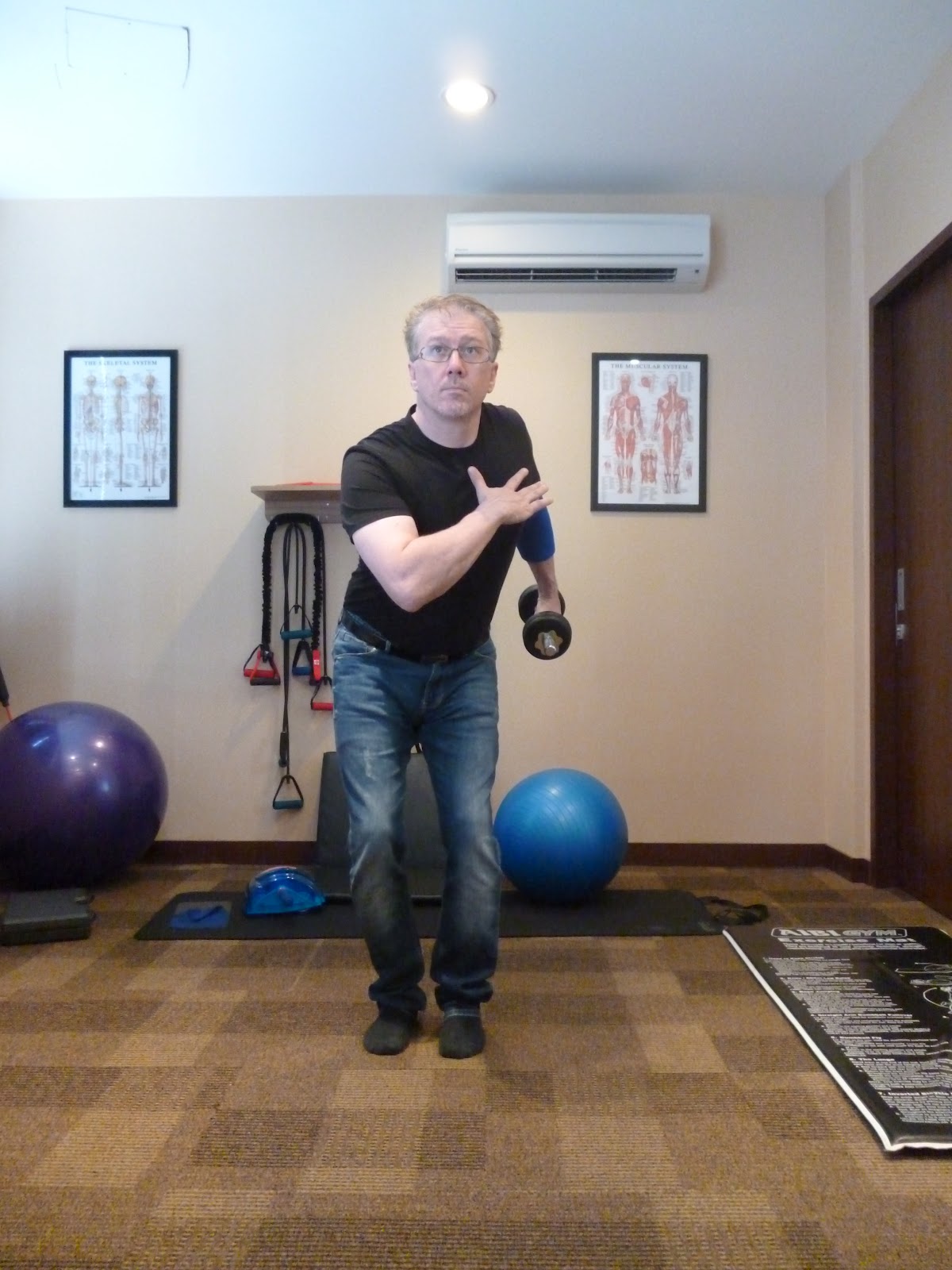
Exercise is extremely important when it comes to overall health. Sure, I love it when a patient tells me they are doing palates, yoga, swimming (on a regular basis),...but, it is also important to do daily stretches to prevent injury, as well.
The exercises you will see here are regular exercises performed IN CLINIC. I have had patients ask me to post this for a while, to give them a reminder of how the exercises should be performed.
So,...let's begin,...shall we? (THIS NOTE WILL BE HERE UNTIL ALL THE EXERCISES HAVE BEEN LOADED>...then I will delete this note).
| Circle Abduction |
| Circle abduction: circular motion (outside to inside) |
| Circle abduction: abduct/ extension |
| shoulder shrugs (3kg) |
| Circle Abd'n w/ ball |
| Bucket Pulls (standing Oblique) |
| Soccer Throw |
| Isolation Tricep Curls |
| (Iso Tricep Curls) |
| Standing Flys |
| bicep curls (w/ anything) |
| Thoracolumbar torque |
|
|
| Ipsilateral Seated Bicep Curls |
| Oblique Stretches |
| Iliopsoas Stretch |
| chest press w/ ball |
| Wabble Stick/Balance Cushion |
| chest press using the wall |
| triceps curls using barbells |
| Puma Crawl (scoliosis training) |
| Pec-Stretch with exercise band |
| Quadriceps Strengthening |
|
|
| Rhomboid stretch using door (Stretches deltoid muscle as well) |
| Hamstring Stretch |
| Hamstring & Gastrocnemius stretch |
| Lawnmower Pulls |
Deltoid Strengthening
|
Sunday, May 20, 2012
Scoliosis...how to properly treat it.
Scoliosis... Let's first talk about the DEFINITION of scoliosis.
Scoliosis is the Lateral curvature of the spine with a convexity greater than 20 degrees. (In plain English) It is when you look at someone from behind and see a curve in their back. When measured by Cobb's Angle (manual measurement source used by M.D's and Chiropractor's alike), the angle is greater than 20 degrees.
This is about all the chiropractors and medical doctors agree upon though. Many medical doctors recommend things like swimming, or simply waiting until the curve gets to an uncontrollable level, that surgery or bracing is the only choice.
In our clinic, we believe in trying to prevent the disease as much as possible.
Okay,...now we explained WHAT scoliosis is,...but HOW does one obtain scoliosis? Approximately 50% of the time it is believed to be inherited (genetic), the other times by trauma. Trauma part is the tricky part. For many times when the initial injury occurs, there is no sign of injury. (On radiographs (Ronson's), there is no sign of fracture or movement of bone). But, I want you to think of a wave.
There is a WAVE effect. This sine wave effect happens immediately, but the visual and painful effects may take years to take place. There are clues that a doctor will look at when we try to diagnose the cause of injury.
1) The convexity of the curve is not Right thoracic or Left Lumbar.
- There may be only one curve, or it may be an opposite side of normal convexity. Most of the
convexities are Right Cervicothoracic and Left Thoracolumbar. (~80%).
2) Patient had a prior trauma during the growth period of their lives (ojek/motorbike...fall off the bike)
- Like I said, there may not have been any signs of injury just POST accident, but the sine wave effect is great.
There have been many studies done on how to decrease the scoliotic curve, both in the medical profession and in the chiropractic profession, as well. Restriction or confinement by
The best way is to brace. Why is that?...Well, I try to tell patients to think of a "lead pipe". Think of how you would straighten that out? By taking a hammer and hitting it everyday? No,...not really.
But, if you put it in a vice, and then torque it,...and HOLD it in that position for hours or even days,... the curve of that lead pipe will be decreased.
But, when we are using this analogy, remember that is a PIPE we are talking about,...not a human being. Remember we are dealing with the psychology of patients. Especially young children. (girls in particular since girls are 10x more likely to get scoliosis than boys). They simply WON'T wear the brace because of ridicule, "it's too tight and makes the back feel really stiff, embarrassment, feeling inadequate, the cost, the bulkiness, or simply lack of discipline (among other reasons). Whatever the reason, the psychology of the human mind plays a big part on why people will NOT wear it.
Therefore, bracing hasn't been as successful as people have hoped it would be,...only due to people not being proactive in their own care.
So, how do we rectify or 'better' that situation... We do A LOT of in clinic work.
a) Proprioceptive exercises.
b) muscle stretching and strengthening to properly activate muscles on the concave side of scoliosis.
c) Torsion exercises to promote behavioral training of muscles and biomechanical structure.
d) advanced chiropractic adjusting. Adjusting specifically for prescoliotic or scoliotic patients.
e) promote an environment that patients feel they can succeed at.
Scoliosis is the Lateral curvature of the spine with a convexity greater than 20 degrees. (In plain English) It is when you look at someone from behind and see a curve in their back. When measured by Cobb's Angle (manual measurement source used by M.D's and Chiropractor's alike), the angle is greater than 20 degrees.
This is about all the chiropractors and medical doctors agree upon though. Many medical doctors recommend things like swimming, or simply waiting until the curve gets to an uncontrollable level, that surgery or bracing is the only choice.
In our clinic, we believe in trying to prevent the disease as much as possible.
Okay,...now we explained WHAT scoliosis is,...but HOW does one obtain scoliosis? Approximately 50% of the time it is believed to be inherited (genetic), the other times by trauma. Trauma part is the tricky part. For many times when the initial injury occurs, there is no sign of injury. (On radiographs (Ronson's), there is no sign of fracture or movement of bone). But, I want you to think of a wave.
There is a WAVE effect. This sine wave effect happens immediately, but the visual and painful effects may take years to take place. There are clues that a doctor will look at when we try to diagnose the cause of injury.
1) The convexity of the curve is not Right thoracic or Left Lumbar.
- There may be only one curve, or it may be an opposite side of normal convexity. Most of the
convexities are Right Cervicothoracic and Left Thoracolumbar. (~80%).
2) Patient had a prior trauma during the growth period of their lives (ojek/motorbike...fall off the bike)
- Like I said, there may not have been any signs of injury just POST accident, but the sine wave effect is great.
![]() |
| Typical Right Thoracic Convex Scoliosis |
There have been many studies done on how to decrease the scoliotic curve, both in the medical profession and in the chiropractic profession, as well. Restriction or confinement by
The best way is to brace. Why is that?...Well, I try to tell patients to think of a "lead pipe". Think of how you would straighten that out? By taking a hammer and hitting it everyday? No,...not really.
But, if you put it in a vice, and then torque it,...and HOLD it in that position for hours or even days,... the curve of that lead pipe will be decreased.
![]() |
| This is how straight your back should look. If crooked,. what kind of tools would it take to bring this pipe back to being straight? |
But, when we are using this analogy, remember that is a PIPE we are talking about,...not a human being. Remember we are dealing with the psychology of patients. Especially young children. (girls in particular since girls are 10x more likely to get scoliosis than boys). They simply WON'T wear the brace because of ridicule, "it's too tight and makes the back feel really stiff, embarrassment, feeling inadequate, the cost, the bulkiness, or simply lack of discipline (among other reasons). Whatever the reason, the psychology of the human mind plays a big part on why people will NOT wear it.
Therefore, bracing hasn't been as successful as people have hoped it would be,...only due to people not being proactive in their own care.
So, how do we rectify or 'better' that situation... We do A LOT of in clinic work.
a) Proprioceptive exercises.
b) muscle stretching and strengthening to properly activate muscles on the concave side of scoliosis.
c) Torsion exercises to promote behavioral training of muscles and biomechanical structure.
d) advanced chiropractic adjusting. Adjusting specifically for prescoliotic or scoliotic patients.
e) promote an environment that patients feel they can succeed at.
| 11 yr. old girl pre-scoliotic. Exercises and adjustment |
Chiropractic-First and Dr. Giovanni (Intro video)
We have been introducing a lot of torsion (torque) exercises, with muscle proprioceptive training. The results have been astounding. Now, granted these patients come in 2-3 x a week and they are extremely proactive in their care. So, don't think these results are typical. Atypical,...only because most patients generally expect the chiropractor to fix everything and they can sit back and do nothing.
There can always be some type of improvement. We presently have a 60 year old woman with a +50 degree typical Right Convex cervicothoracic curve and a typical Left Convex thoracolumbar curve...and in 3 weeks at 3 x a week, ... she has shown massive improvements. By seeing these improvements, this has given her further motivation to go further. So, her confidence is almost as high as her NEW quality of life.
Remember to have your daughters (especially daughters) checked for scoliosis by age 10. Especially if you have a family history of scoliosis. Girls get scoliosis 8-10 x more than boys. So, check them out early and save themselves years of distresses pain. Thank you again.
Dr. G
Subscribe to:
Posts (Atom)